



Wet, tired, and covered in mosquito bites, I couldn't shake the feeling that the jungle was watching us.
I was on a camping trip in the Amazon rainforest with my partner and a few friends. We had recently flown into Leticia and spent the past three days hiking through the bush, sleeping in hammocks, and weathering the torrential rain that drenches the Amazon basin on a daily basis.
I needed a disconnection from the constant bombardment of modern life: my phone, looming tax deadlines, bills, and the constant temptation to doomscroll Reddit at the slightest hint of boredom or insomnia.
So, off we went — to brave one of the most remote places on Earth.
The Amazon jungle is a rough place. Living here is difficult and highly dangerous. There are threats everywhere you look, you're always wet, the bugs are relentless, and the humidity makes even the simplest tasks exhausting.
The forest feels alive, like its own living and breathing organism. It makes daily offerings in the form of succulent fruit, fish, and a vast pharmacopeia of medicinal plants… but it also demands respect. Snakes, jaguars, spiders, deadly infection, and insidious parasites are constant threats here.
One night, while sitting around the campfire as we tried (unsuccessfully) to shroud ourselves in the smoke of the fire to repel the ravenous swarms of hungry mosquitoes, we listened intently to our guide, a native from a local village called San Pedro, as he shared with us the many legendary stories from deep within the Amazon rainforest.
These are stories passed down through generations. Some contain important lessons. Others attempt to explain the unexplainable. Others are merely meant to captivate the impressionable minds of children.
I've always felt that listening to local legends is one of the most powerful ways to understand the worldview of a particular culture. They reveal fears, values, collective memories, and the relationship between people and their environment in ways scientific analysis and surveys simply can't match.
The key element I took from these stories is that the Amazon is just as full of spirits as it is of plant and animal life. Some of these spirits are benevolent; others are decidedly malicious and cruel.
From shapeshifters with backward feet to river dolphins that transform into seductive strangers, these legends serve as cautionary tales about what it means to live in such a wild, untamed place.
Of all the stories our guide shared, these are the three that stood out to me the most.
The human names used in these stories are completely made up, but the essence remains intact. These stories offer a glimpse into how the indigenous shamanic-based cultures living here have interpreted mysterious forces at play in the world's largest rainforest.
1. The Curupira: Shapeshifter
Daniel had always been captivated by the mysteries of the Amazon rainforest. Its raw power and untamed beauty had drawn him in since he was a young boy.
Shortly after Daniel turned 26, just a few weeks after graduating from university, he booked himself a trekking trip to the Amazon rainforest. This was no ordinary tour; it involved taking a boat ride 9 hours out of Leticia, Colombia, then hiking for 3 days into the depths of the jungle, before eventually reconnecting with the Amazon River to catch a boat back to the city.
Daniel was experiencing some existential issues with his life direction at the time. He had recently broken up with his long-time girlfriend and after graduating from university, was at a crossroads for what to do next. Part of the motivation for this particular adventure was to reconnect with himself and (hopefully) find some newly inspired direction for his life.
From the moment his journey began, Daniel bonded with the camp cook — a Peruvian man who shared a lot in common with Daniel. He too felt lost in life, working as a cook for the tour agency to make ends meet. His real aspirations were to become an artist documenting the rainforest's vanishing species.
One evening, after the group finished their supper and began, one by one, zipping themselves into their hammocks to keep the mosquitoes and other crawlers out for the night, Daniel remained outside, contemplating life and enjoying the glow from the fire. He was blown away at the vastness of the Amazon rainforest. It was loud, vibrant, and full of life.
Daniel noticed a figure approaching from the edge of the camp. In the dim moonlight, it took a moment to recognize him — it was the cook, who gestured for Daniel to follow him. "Come," he whispered. "I want to show you something amazing." Curious, Daniel got up and followed his new friend into the jungle.
"Where are we going?" Daniel asked, growing uneasy as they moved farther from camp.
"Just a little further," the cook replied.
After a few minutes, Daniel stopped — "I think we should head back. It's not safe to wander at night."
The cook turned, and in that moment, Daniel could swear one of the man's feet was facing the wrong way. This caused a chill to run down his spine. Something was wrong.
"I need to go back," Daniel said firmly, backing away slowly.
The figure smiled, and in that split moment under the moonlight, Daniel felt a shiver run through him as he noticed the man's eyes shifted unnaturally — betraying his true intentions.
"Are you sure? The forest has much to show those who seek direction."
Daniel turned and ran back toward camp, using the distant glow of the fire as a guide. When he arrived, breathless and shaken, he was stunned to see the cook stirring a pot of cocoa over the fire.

What is the Curupira?
Daniel's story is a tale of the Curupira — a shapeshifter that transforms into a familiar figure, an attractive woman, or a wild animal in order to lure its victims into the dense Amazonian jungle where they're never seen again.
The Curupira is a prominent figure in Amazonian folklore, particularly in Brazil, Colombia, and Peru. It's typically depicted as a small, impish being with fiery red hair and backward-facing feet. The Curupira isn't overtly evil or malicious, but serves as a mischievous protector of the forest and its inhabitants.
The backward feet are the Curupira's most distinctive feature. Some believe the purpose is to create footprints that trick those who try to follow them. This confuses hunters, loggers, and others who seek to harm the forest, causing them to become hopelessly lost.
While primarily seen as a trickster and guardian, the Curupira's nature varies across different cultures.
In Brazil, he's often portrayed as more mischievous and protective, while in Peruvian and Colombian versions, he can be vengeful and dangerous to those who even mildly disrespect the forest.
Most stories involving the Curupira describe him (or her?) luring hunters and poachers deep into the jungle until they succumb to exhaustion, snake bites, or any of the forest's many other dangers. The Curupira rarely, if ever, takes its victims itself, but instead allows the forest to take them as it sees fit.
The legend of the Curupira serves as both a cautionary tale against exploiting nature and a reminder of the rainforest's mysterious power. It reflects indigenous beliefs that the natural world has spiritual guardians who ensure balance and respect between humans and the environment.
So, what drew the Curupira to Daniel? Nothing in this story directly implicates him as a threat to the forest.
There's no way to know for sure. The curupira operates on its own mysterious logic. Perhaps he carried something within him that threatened the forest — commercial ambitions, unconscious destructive desires, or a disrespect for natural boundaries.
I asked our guide this question, and he seemed to think it was something Daniel had done previous to engaging on his soul-searching journey in the rainforest.
2. The Mapinguari: Amazonian Sasquatch
Rafael was deep in the Peruvian Amazon. He was hunting rare rosewood trees for an illegal logging operation he worked for.
These ancient giants, prized for their fragrant oils and luxurious timber, require destructive harvesting methods to be obtained. Once a tree is found, Rafael would mark the path and return a few days later with a crew to chop it down and harvest. This style of logging is highly unethical and leads to massive destruction of Amazonian biodiversity. Trees must be cut to clear a path for heavy equipment, which results in the destruction and devastation of large sections of pristine forest.
Rafael had made treks just like this one over a dozen times already — typically by himself. This time, however, he brought along Marco, a nervous new recruit the company recently hired.
After three disorienting days in the jungle, a storm suddenly swept in, catching the duo off guard. They raced to set up camp, selecting to shelter against a massive fallen log to help block the heavy rain. A few hours later, as the storm subsided, Rafael left to gather firewood. He left Marco behind to take down the camp.
When he returned about an hour later, Marco had vanished. Despite hours of searching, Rafael found only one of his companions' shoes, which was abandoned near the edge of a nearby creek.
It was then that he realized something much more chilling — the enormous log they had anchored their tarp against was gone too.
Terrified by what may have happened to Marco, Rafael decided to abandon his search and head back to the city. Twice, Rafael thought he heard Marco's voice calling to him from beneath the earth or inside fallen logs.
When Rafael finally reached a small village on the edge of the Amazon River, he was delirious, rambling about a walking log that had devoured his friend. The villagers exchanged knowing glances as they helped him flag down a boat heading back toward the city.
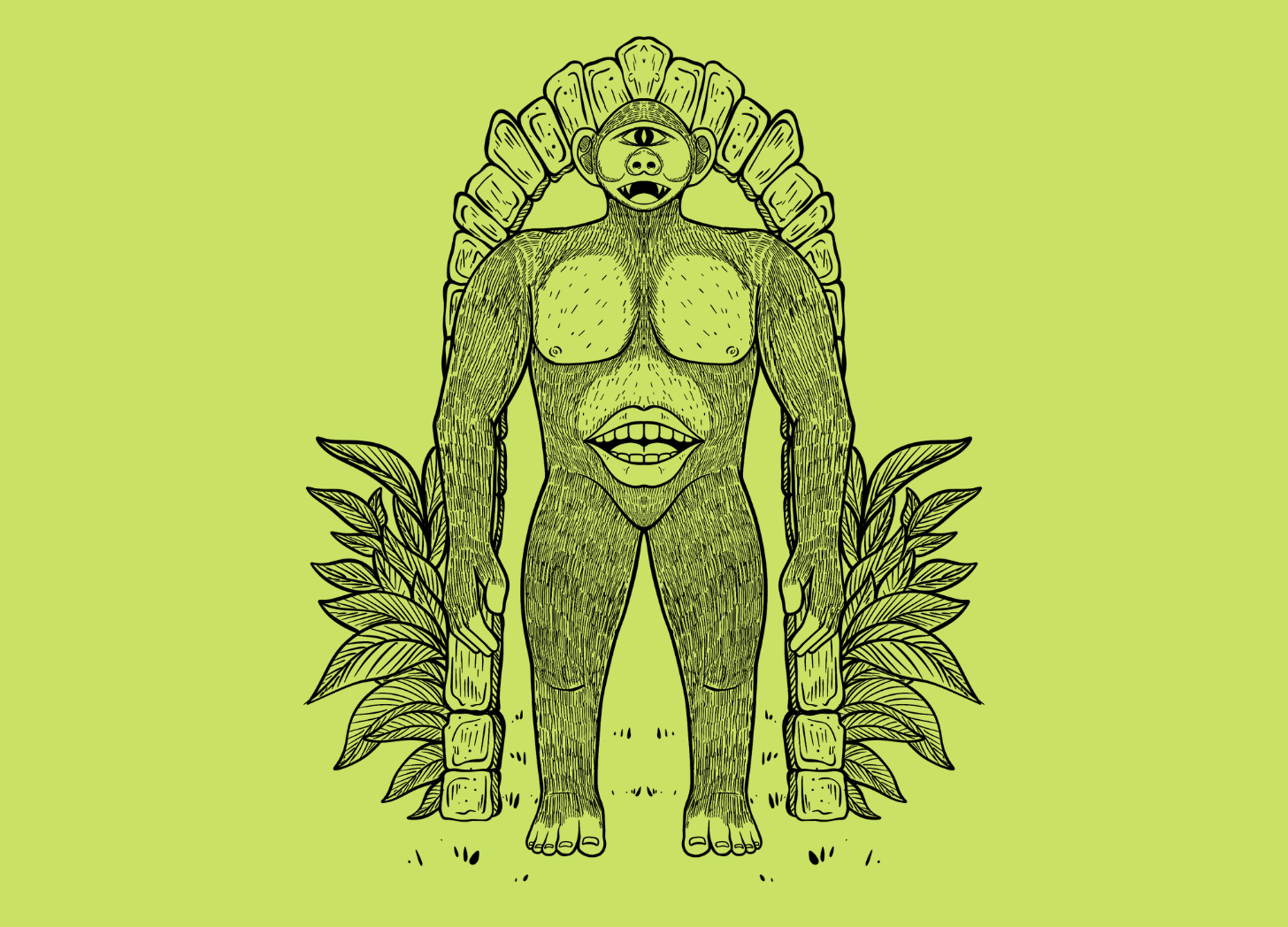
What is the Mapiguari?
Marco was likely a victim of the Mapiguari — which is essentially the "Bigfoot" of the Amazon rainforest (with some creative differences, of course).
This hulking beast stands a towering 7 to 10 feet tall and combines the elements of a sloth and a bear. It's covered in long, thick fur that allows it to masterfully blend into the jungle. His thick, matted hair is so coarse it looks just like the bark of a tree. When the towering Mapioguari sleeps, he is often mistaken for a fallen log.
Where things get really interesting is its strange anatomy. The Mapiguari sports a giant gaping maw, which is located not on his face, but on his belly — large enough to swallow a human whole before they even have a chance to scream.
Unlike the trickster energy of the Curupira, the Mapiguari represents the raw, primal vengeance imposed against those who intend on harming the forest.
The Mapinguari is prevalent throughout Amazonian cultures — it's an ancient legend told by the people spanning the lower Amazon basin all the way up to the Brazilian highlands. The legend remains similar across the vast Amazon, but with a few regional differences:
Brazilian legends depict the mapiguari as a selective predator — targeting those who overhunt or destroy forest habitats while leaving respectful travelers unharmed.
In Peruvian folklore, the creature is more indiscriminate and feared, attacking anyone who ventures too far into its territory, regardless of their true intentions.
Some anthropologists suggest the Mapiguari originated from ancestral memories of the giant ground sloths that once inhabited South America (now extinct). Indigenous peoples maintain that the creature still patrols the deepest, most sacred parts of the Amazon.
3. The Boto: Seductive Stranger
Maria lived in a small riverside village in the Amazon basin. During the annual Festival of São João, she noticed a handsome stranger with pale skin, elegant clothes, and a straw hat pulled low over his head.
"Who is that?" Maria asked her friend Luisa.
"I don't know," Luisa replied. "Must be from out of town. But be careful, Maria — remember the stories."
Maria was headstrong and disregarded her friend's warning. She approached the stranger and asked him for a dance.
His touch was cool, but his smile was intoxicating. They danced until midnight before he invited her for a moonlit walk.
As they strolled beside the dark waters, he told her of underwater caves glowing with strange light and treasures hidden beneath the currents. "I could show you," he said. "Come with me, just for a little while."
Maria hesitated. "I should return. My mother will worry."
"Just a glimpse," he insisted, his voice melodic and persuasive. "We won't go far." He took her hand, leading her toward a secluded bend in the river where the water gleamed gold under the full moon.
"It's beautiful," Maria whispered, entranced by the way the moonlight danced on the surface.
"The real beauty lies beneath," he said, stepping into the shallow water. "Come."
Something in his voice made refusal impossible. Maria, in a trance, removed her sandals and followed him into the river. She liked the way the water felt against her skin.
As the water reached her waist, a sudden breeze blew the stranger's hat from his head. In the bright moonlight, Maria saw it clearly — a small, dark blowhole at the crown of his head. Terror seized her as she realized what he was, but when she tried to pull away, his grip tightened with inhuman strength. She was never seen again.

What is the Boto?
The Amazon river dolphin, or "Boto," is one of the most enchanting figures in South American folklore. Unlike forest guardians like the mischievous Curupira or the powerful Mapinguari, the Boto embodies a more predatory spirit — targeting and exploiting human desire rather than protecting the environment.
The legend says that at night, the pink river dolphin transforms into a handsome, well-dressed man — usually a “gringo” with pink skin and hypnotic eyes. He wears a fancy outfit fashioned from creatures living in the river — shoes made from river fish, a belt fashioned from an eel or python, a crab watch, and a stingray hat.
His disguise is nearly perfect, except for two key details:
He cannot transform his blowhole (hence the need for a hat to cover his head)
He cannot roll his R's (possibly in connection with the "gringo accent")
Using his disguise, the Boto seduces young women with irresistible charm before leading them into the water. Sometimes he allows the women to return to their families; other times, he keeps them in his underwater realm forever.
This myth was traditionally used to explain unexpected pregnancies — "the Boto's child" is a culturally accepted term for children born outside marriage in certain parts of the Amazon. It's long served as a convenient scapegoat for sexual violence and exploitation throughout the Amazon basin and is an embodiment of the exploitative influence foreigners have exerted on indigenous women for generations.
Some communities believe eye contact with a Boto brings nightmares, while others consider them sacred creatures that should never be harmed.
Despite their menacing portrayal, Boto dolphins are protected in many indigenous cultures. Killing them is taboo and is believed to bring misfortune or illness.
More Than Myths: How Amazonian Legends Shape Culture & Morality
These three legends — the Curupira, Mapinguari, and the Boto — represent just a fraction of the rich mythology that permeates Amazonian culture.
What makes these stories so compelling isn't just their supernatural elements, but how they function as a window into the collective unconscious of the people who call this vast rainforest home.
The Curupira's protection of the forest reflects indigenous concern over resource exploitation and the importance of respecting natural boundaries.
The Mapinguari embodies the raw, destructive consequences of greed and environmental disrespect.
The Boto reveals complex social dynamics, gendered vulnerabilities, and the exploitative relationships between outsiders and indigenous communities.
The Amazon is home to countless other legendary beings equally rich in symbolism and cultural significance — I've merely grazed the surface of this topic.
If you like these stories, I recommend you check out some of these other legends:
The Yacumama — an enormous water serpent believed to cause unexplained river disturbances and flash floods.
The Caipora — a small, agile forest dweller who protects animals from excessive hunting.
The Matinta Pereira — a shape-shifting witch who announces her presence with an eerie whistle in the night.
Despite their fantastical elements, these stories serve a practical function. They carry both warnings and wisdom, encoding generations of ecological knowledge and social boundaries into memorable narratives that anyone — even a child — can understand and remember.
Whether you believe in these spirits or not, their lessons resonate with two universal truths — that the natural world demands our respect and our actions have consequences.
Further Reading
Enjoying Tripsitter? 🍄
Don’t Journey Alone! Tripsitter was built by a community of psychedelic advocates — but it’s people like you that allow us to thrive.
You can also follow us on Bluesky or subscribe to our Reddit.