

Prohibition Returns in 2026: And It’s Worse Than Before
Instead of fixing the real problems — contamination, fake COAs, sketchy labs — lawmakers chose prohibition. And history tells us what happens next: stronger drugs, dirtier products, higher risk.


On November 12th, 2025, the US Senate voted 60–40 to advance a bill to reopen and re-fund the federal government.
Hidden inside that 1000+ page package — wedged between routine budget lines and totally unrelated policy riders — was something almost nobody saw coming…
A federal ban on nearly all hemp-derived THC products.
There were no hearings. No public input.
Just a silent and surgical prohibition slipped into an otherwise critical bill.
Nobody asked for this.
Not the consumers who rely on THC for sleep, pain, or stress.
Not the farmers who rebuilt their livelihoods around the 2018 Farm Bill.
Not the retailers or manufacturers — and certainly not the millions who turned to hemp precisely because it was the legal, (semi-) regulated alternative to illicit markets.
And yet, with just a few paragraphs of buried legislative text, Congress reversed seven years of progress and set the clock back toward a nationwide prohibition of cannabis… again.
What makes this even stranger is that the problem has never been THC itself. It’s always been the manufacturing chaos surrounding it — sketchy labs, mislabeled gummies, “diamond-dusted” THCa flower, solvent-soaked vapes, fake COAs, and cheap imported biomass contaminated with heavy metals.
The irony is that THC itself has one of the safest toxicity profiles of any widely used psychoactive substance.
There are no robust, peer-reviewed evidence that pure THC intoxication has caused fatal overdose in humans. Fatalities linked to cannabis use are rare and overwhelmingly associated with contamination, adulterants, polysubstance use, or indirect causes (accidents, cardiac issues, etc.), not acute THC toxicity.
This whole thing feels less like science-based policy and more like political bookkeeping — an attempt for Mitch McConnell to tidy up a legacy complicated by the very loophole he helped create.
The worst part is that, unlike past crackdowns, this is the first time in US history the government is outlawing a drug after legalizing it and allowing a nationwide consumer market to form and develop into a multibillion-dollar industry (currently valued at $28 billion).
Millions of Americans use hemp-derived THC for sleep, stress, pain relief, and for many — particularly veterans — for managing symptoms of PTSD.
Unless something changes, the entire industry will disappear next November.
Let’s take a closer look at some of the most significant snippets of the bill (full text here).
What the Bill Actually Says (and Why It Matters)
When you strip away the noise, the ban comes down to a few deceptively simple lines buried deep in the government funding bill.
1. The New Definition of “Illegal THC”

That line states that any hemp product containing more than 0.4 mg of total THC per container is prohibited.
Not per serving. Per container.
This single line effectively bans:
Delta-8
Delta-9 (hemp-derived)
Delta-10
THCP
HHC
THCa flower
This change makes the previous 0.3% THC-by-weight standard irrelevant.
So, whether you have a 5 mg gummy, a 50 mg gummy, or a gram of THCa flower, it’s all illegal under the new regulations.
2. Explicit Language Targeting Cannabinoid Isomers & Derivatives

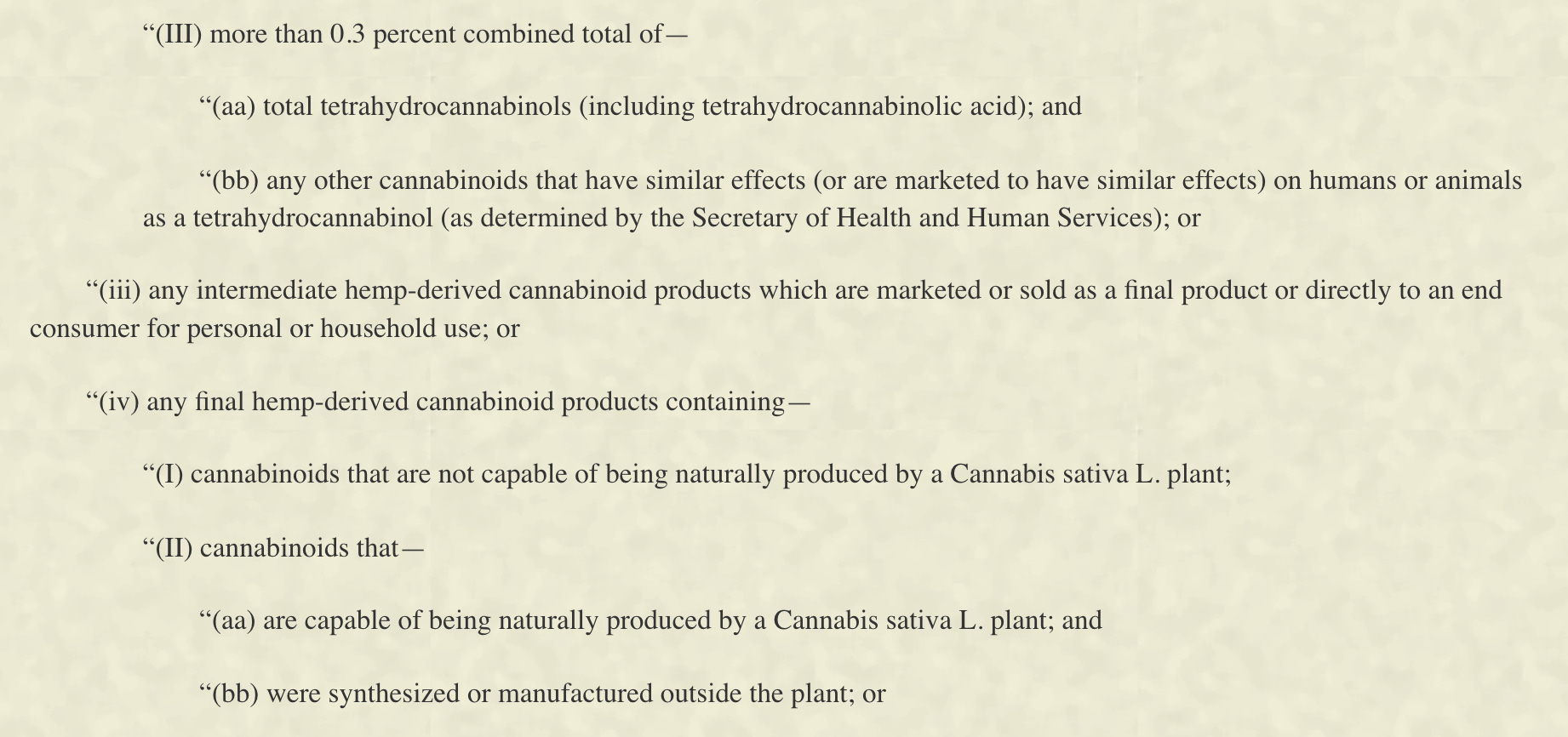
Older Farm Bill language accidentally left wiggle room for “isomers,” “derivatives,” and naturally occurring hemp compounds. This bill closes that loophole.
It explicitly schedules:
“Any intoxicating cannabinoid derived from hemp”
“Any isomer, derivative, or analog of THC”
“Any product intended for human consumption containing total THC above the threshold”
This wording is broad enough to capture nearly every form of hemp THC — past, present, and future — as well as secondary cannabinoids that were never meant to be targeted — like CBN, THCV, and several CBD metabolites.
3. What Remains Legal?
Not everything is wiped out. The bill clearly exempts:
CBD products containing little to no THC (so just CBD isolates)
Industrial hemp for textiles, grain, seed, and building materials
Non-intoxicating extracts that fall below the 0.4 mg limit
But here’s the catch: most standard full-spectrum CBD oils contain trace amounts of natural THC that exceed 0.4 mg per bottle.
Those products now require reformulation — or they become illegal — even though they’re completely non-intoxicating.
Reformulation comes with real consequences.
Most companies will be forced to switch from full-spectrum CBD to CBD isolate, which is both weaker and less therapeutically effective.
If you’ve been using a high-quality full-spectrum extract, you’ll likely feel a noticeable drop in potency — especially in areas like sleep, anxiety reduction, and pain modulation, which rely on the synergistic effect even tiny amounts of THC provide.
CBD isolate works, but it’s not the same. Full-spectrum extracts deliver benefits through the entourage effect — a cooperative interplay of cannabinoids and terpenes that’s well-documented in both clinical and preclinical research.
This bill removes that option for millions of people who depend on it, even though full-spectrum CBD has never posed a public-health risk.
4. Enforcement Starts November 2026… ish
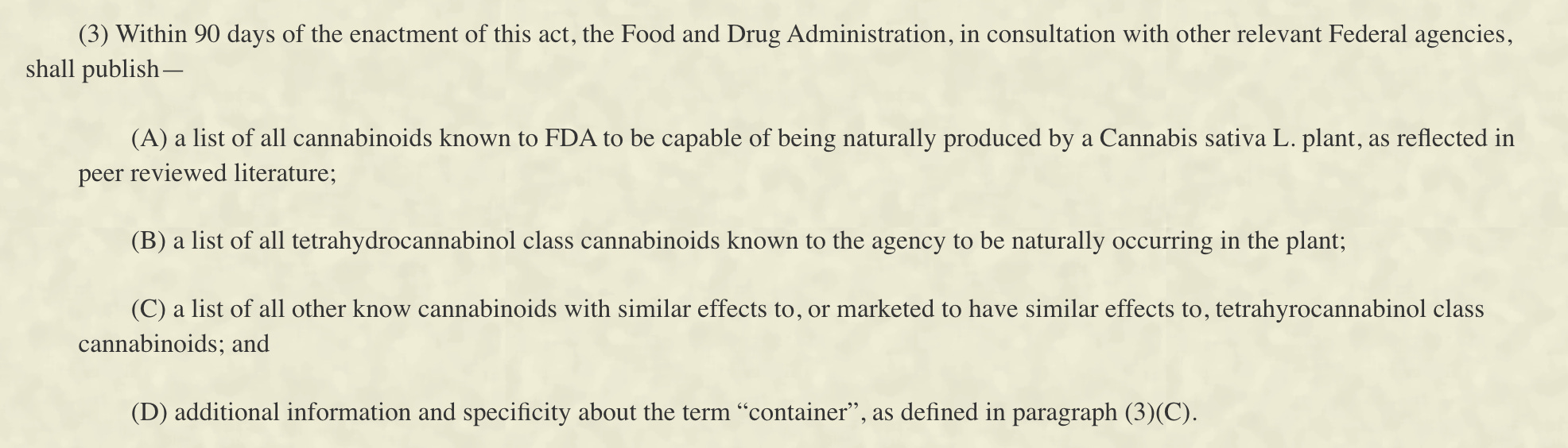
This section indirectly marks where the clock starts.
The bill gives the FDA 90 days to publish an official list of cannabinoids.
Once that list is published, the new THC definition becomes active, and federal agencies have a 12-month enforcement window before penalties begin — which is why the ban takes full effect one year after this list is released — likely around November or December 2026… depending on how quickly the FDA responds.
This gives businesses roughly 12 months to:
Sell off inventory
Reformulate everything to CBD isolates
Rebrand entire product lines
Pivot into non-intoxicating cannabinoids or botanicals
For large corporations, a 12-month overhaul is expensive but survivable. But for everyone else, it’s likely an extinction-level event.
Small hemp brands don’t operate like Big Pharma. They don’t have multimillion-dollar compliance teams, legal departments, or the liquidity to trash their entire product catalog and rebuild from scratch.
Most operate on 90-day inventory cycles and razor-thin margins. Many still haven’t even recovered from post-COVID supply chain shocks.
What’s Missing From the Bill Is Just as Important as What’s In It
One of the most revealing parts of this new law isn’t the ban itself — it’s everything that isn’t there.
If lawmakers were genuinely trying to protect the public, you’d expect at least some guardrails, pathways, or standards to replace the products they’re eliminating.
You’d expect the kind of similar oversight we already use for supplements, herbal extracts, alcohol, and even over-the-counter cold medicines.
Instead, the bill contains NONE of the mechanisms that would actually make hemp-derived products safer.
There is no:
Regulated alternative to hemp THC
Licensing structure for compliant manufacturers
Manufacturing standards or contamination limits
Age-gating rules or purchase restrictions (these currently only exist for vapes)
GMP requirements for extraction labs
Testing requirements (pesticides, heavy metals, solvents, microbes)
Medical exemptions for chronic pain, PTSD, or sleep disorders
Consumer safety guidelines of any kind
This isn’t public health reform — it’s prohibition, pure and simple.

Why Prohibition Has Never Made Any Drug Safer
If this ban feels familiar, it’s because we’ve tried it before — for more than a century. Alcohol, cannabis, MDMA, psychedelics, kratom, and now hemp THC have all taken a turn as political villains. And every time, the results are the same:
Products don’t disappear (they move underground)
Potency increases (black markets always chase efficiency)
Contamination becomes the norm, not the exception
Regulation evaporates
Consumers shoulder all the risk
We’ve covered this concept extensively on Tripsitter. The War on Drugs has never been about the chemistry of substances — it has always been about controlling the people who use them.
Drugs become dangerous when the government pushes them into environments where safety, transparency, and accountability can’t exist.
When alcohol was banned in the 1920s, people didn’t stop drinking — they started drinking stronger, unregulated, and often toxic bootleg spirits.
When synthetic cannabinoids (like Spice and K2) were banned, it only incentivized chemists to tweak molecules over and over again, creating a constant arms race of newer, more potent, and more dangerous versions hitting the streets.
When MDMA was banned in the 1980s, it didn’t slow down use — but it did increase contaminants, mislabeling, and medical emergencies.
And when “crackdowns” hit psychedelics, research didn’t stop — it just moved into basements, garages, and clandestine chemistry labs.
In every case, prohibition turned a manageable situation into a hazardous one. It replaces oversight with improvisation, and transparency with guesswork — a trade-off that has never made the public safer.
What You Can Do About It
This ban only happened because lawmakers assumed the public wouldn’t notice — and because the worst parts of the hemp market gave them plenty of ammunition.
It also slipped through because it was attached to a government reopening bill.
After a 43-day shutdown — the longest in U.S. history — Congress had no more time or leverage to push back on the fine print. The bill had to pass, no matter what was hiding inside it.
But this isn’t over.
Congress revises and amends legislation constantly, especially when voters, industry groups, and advocacy organizations force an issue back into the spotlight.
Here’s what you can do, right now, to make a difference.
1. Call Your Representatives
The biggest failure here wasn’t that Congress cracked down — it’s that they chose the bluntest, least intelligent option available (shocker).
The gray market absolutely had problems — but rather than regulating the bad actors (as is already done with supplements, herbal products, and food manufacturing), lawmakers banned the entire category.
Call your representatives and tell them exactly that:
You oppose the hemp-THC ban hidden in the 2025 spending bill.
You want testing standards, age restrictions, GMP rules, and real manufacturing oversight, not prohibition.
You want hearings and public debate — the process was unacceptable.
A 30-second call genuinely changes how staffers frame the issue internally.
2. Talk About the Real Problem
The hemp industry didn’t get in trouble because of cannabis. It got in trouble because:
Brands were synthesizing cannabinoids with all sorts of toxic chemicals and impurities.
Vapes were filled with unknown oils, leftover solvents, and heavy metals.
Imported hemp biomass is often full of heavy metals and other contaminants.
Lab-shopping and fake COAs became the norm.
The same lack of transparency that enabled Spice, EVALI, and Diamond Shruumz-style disasters began creeping into hemp.
The government didn’t step in when the industry needed standards — they stepped in when it was too late and went straight to prohibition.
When you write or talk about this bill, make this point clear — we needed smarter regulation, not a blanket ban.
3. Support Ethical Hemp Brands
If you’re buying hemp products between now and 2026, choose companies that are already operating like regulated supplement manufacturers. That means:
Clean THCa flower (no sprayed “diamonds,” no chemical moonrocks)
Simple, transparent product formulations
Real third-party testing with QR codes that verify the COA on the lab’s website
Batch numbers that actually match
No impossible potency claims
No mystery “proprietary cannabinoid blends”
No imported biomass with questionable heavy-metal history
4. Prepare for November 2026
Enforcement begins sometime around November 2026 (we’re still waiting for the FDA list to kick off the countdown), and unless something changes, your access to hemp-derived cannabinoids will change dramatically.
THCa flower, gummies, tinctures, sleep formulas, and softgels all store well, freeze well, and remain stable for years when sealed properly.
If cannabinoids are part of your sleep, pain, or wellness routine — think ahead and stock up before November 2026.
5. Support Advocacy Groups Who Are Preparing the Fight
Several organizations have already begun mobilizing.
This includes groups like:
Veteran advocacy networks
State-level hemp alliances
These are the organizations drafting amendment language, coordinating legal challenges, organizing lobbying efforts, and building coalitions across the hemp, cannabis, and wellness sectors.
They rely on public support, funding, and visibility to keep this issue in front of lawmakers and push for meaningful fixes before enforcement begins.
6. Tell Your Friends
Most Americans still have no idea this ban passed. The more people learn about it now, the harder it becomes for Congress to remain negligent.
Share the story. Send the screenshots. Inform the people who actually rely on these products for anxiety, pain, PTSD, or sleep.
Because this isn’t just about THC.
It’s about transparency, due process, and whether a government can erase an entire legal and well-established industry without ever allowing the public into the room.
Your voice matters here more than you think.
Thanks for the heads-up on this. I will do my part to contact representatives, help find efforts to push back, and spread the word.