

New Psilocybin Study: A Breakthrough That Cuts Both Ways
New research shows how the psychedelic state can be guided to reshape consciousness. It’s a substantial breakthrough for mental health — but also raises serious concerns about control & manipulation.


Consciousness isn’t static. Who we are at any moment is shaped by memories, past experiences, habits, and beliefs, reflected in a constantly shifting pattern of active brain networks. It changes over time as we accumulate new experiences and reinterpret old ones.
Psychedelics like psilocybin have been studied for decades because of their ability to alter consciousness in ways that can leave a lasting imprint on our conscious experience. People often emerge from psychedelic experiences with different perspectives, beliefs, or entirely new ways of relating to themselves and to the world around them.
In my own experience, a single ayahuasca ceremony completely shifted my life path — forcing me to realize many of the things I believed to be deeply important were illusory. It directly led to a career change and a move across the world. Who I was before the ceremony was a different person from the one who emerged from the other side.
This consciousness-shifting ability has fuelled a ton of research over the past 20+ years. There is now a substantial body of evidence backing the claims that psychedelics can help break addictions, ease depression and anxiety, and help people get unstuck from deep creative ruts.
Over the past two decades, researchers have zeroed in on these powerful qualities. They’ve discovered large-scale systems like the default mode network — a self-referential circuit involved in identity, rumination, and ego — and shown that psychedelics can temporarily dim its influence.
They’ve also discovered mechanisms that promote neuroplasticity — the brain’s ability to form new connections and repair pathways that may have been disrupted by chronic stress, trauma, depression, or anxiety.
But until just a few weeks ago, these changes were largely thought to be diffuse, nonspecific, and chaotic.
That changed just a few weeks ago, when researchers published a new paper titled “Psilocybin Triggers an Activity-Dependent Rewiring of Large-Scale Cortical Networks.”
In this study, the team set out to answer a more precise question:
“If psychedelics make the brain more flexible, where do those changes actually happen — and what determines which circuits are strengthened or weakened?
Can they be guided… or even controlled?”
What they found provides a paradoxically inspiring and unsettling answer to these questions.
It shows that psilocybin doesn’t just alter brain activity in the moment, and it’s not random — it produces a physical and specific rewiring of large-scale neural networks. Those changes depend entirely on which circuits are active during the experience.
In other words, psychedelics may not simply change consciousness — they may physically reshape the biological pathways that create it within our brains.
That discovery represents a major breakthrough for mental health treatment — and raises equally serious questions about how malleable the mind really is.
A New Model for How Psychedelics Change the Brain
Rather than focusing on moment-to-moment brain activity or subjective effects, researchers zeroed in on changes in cortical input patterns following a single dose of psilocybin.
Cortical input patterns describe where a brain region receives its information from — in other words, which other regions are influencing it, and how strongly. These patterns define how perception, memory, emotion, and meaning are integrated into one’s conscious experience.
The study mapped information routing changes throughout the brain before and after a dose of psilocybin.
The results revealed a consistent and non-random pattern of reorganization.
After psilocybin administration, researchers observed lasting changes in large-scale network connectivity, characterized by selective strengthening of some pathways and weakening of others. These changes were not uniform across the cortex and did not reflect generalized increases in connectivity.
The findings are complicated, and more research is going to be required to fully understand the implications of these changes — but let’s try and break down the most important findings one by one:
1. Greater Influence of Perceptual & Medial Brain Regions
Psilocybin shifts the brain’s center of gravity toward direct experience.
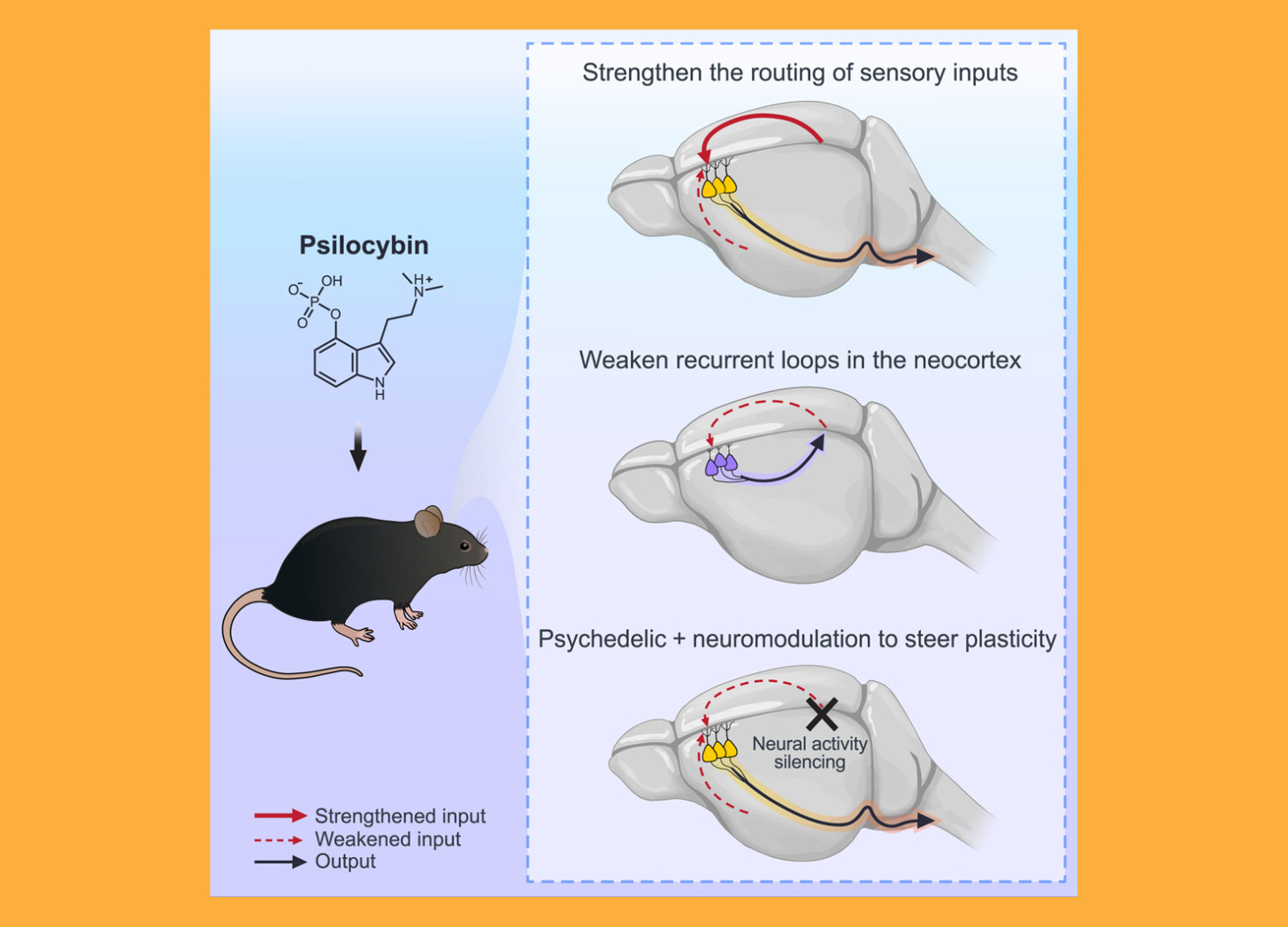
This study showed that psilocybin increases input from perceptual and medial cortical regions — which includes areas considered to be functionally similar to the default mode network. This suggests that sensory and internally integrated information play a strong role in shaping downstream processing.
Implication: Rather than remaining trapped in abstract self-narratives, the brain becomes more responsive to what is being perceived and experienced in the present moment. This may help explain why the world feels more vivid or meaningful during and after psychedelic experiences.
2. Information Is Routed Away From Closed Cortical Loops
The brain becomes less self-referential and more outwardly integrated.
The study found enhanced routing of cortical information toward subcortical targets — reducing reliance on closed cortical feedback loops that repeatedly circulate information within the cortex.
Implication: This shift may weaken rigid, self-reinforcing thought patterns by interrupting the internal echo chambers that sustain them. Instead of endlessly reprocessing the same narratives over and over again, new information is more likely to influence action, emotion, and behavior.
3. Self-Reinforcing Narrative Circuits Lose Dominance
Psilocybin reduces the influence of networks that maintain the “ego.”
Researchers observed a reduced influence of cortico-cortical recurrent circuits, which are strongly associated with self-referential processing, autobiographical memory, and internal narrative maintenance.
Implication: When these circuits loosen their grip, identity becomes less rigid. This may underlie reports of reduced rumination, increased cognitive flexibility, and the sense that long-held assumptions or beliefs are no longer fixed.
4. Rewiring Is Targeted, Not Global
Psilocybin reorganizes the brain selectively, not indiscriminately.
This may be the most important takeaway from the study.
It showed that rather than increasing connectivity across the entire brain, psilocybin produced region-specific restructuring, with certain pathways changing while others remained largely untouched. Most striking of all, these changes could be influenced through activity or chemical silencing of certain brain regions or circuits.
Implication: This finding challenges the idea that psychedelics simply induce neural chaos or entropy. Instead, they appear to facilitate precise, organized network remodeling. It reinforces the idea that context and experience play critical roles in shaping outcomes.
How Scientists Tracked Brain Rewiring Using Rabies
To observe how psilocybin reshapes brain networks, researchers needed a way to map actual wiring, not just temporary activity.
They used a technique called monosynaptic rabies tracing — a method that exploits rabies virus’s unusual ability to travel backward across synapses. By heavily modifying the virus (they eliminated its lethality and hindered its ability to jump more than one synapse at a time). Using a special dye with their new modified rabies, researchers were able to label precisely which neurons directly feed information into a targeted group of cortical cells.
This allowed the team to identify which brain regions gained or lost influence over frontal cortical circuits after a dose of psilocybin.
Because the method tracks physical connections rather than correlated activity, it revealed changes that traditional brain imaging techniques haven’t been able capture in the past. Instead of asking which areas were active, researchers could see how information routing itself was reorganized.
That level of precision is what made the study’s breakthrough findings possible — and why the results carry so much weight.
What This Means for Mental Health Treatment
The most important implication of this study isn’t that psilocybin changes the brain — that much was already clear. It’s how those changes occur and what we can do to focus these effects even further.
If psilocybin selectively strengthens circuits that are active during the experience, it means therapeutic outcomes depend less on the drug alone and more on what the brain is doing during the psychedelic window. This could explain why psychedelics often succeed where conventional treatments fall short.
For depression, this means targeting the rigid, self-referential loops that keep negative narratives locked in place. Therapeutic sessions can be structured to activate circuits involved in presence, self-compassion, and cognitive flexibility while maladaptive feedback loops are dulled temporarily. Over time, these alternative pathways may gain influence, making depressive patterns easier to disrupt.
For anxiety, the focus shifts toward retraining how the brain responds to uncertainty. When fear-based prediction circuits quiet down, patients are more receptive to experiences of acceptance or grounded awareness. Reinforcing those states during the psychedelic window further reduces the brain’s tendency to default towards hypervigilance and anxiety-driven threat monitoring.
For addiction, where behavior is driven by unconscious habits and faulty cue-response loops, psilocybin offers a chance to weaken compulsive pathways while strengthening circuits tied to meaning, agency, and long-term values. Rather than suppressing cravings with drugs, psychedelic therapy can help rewire the underlying systems that sustain these addictions in the first place.
These findings point toward the possibility of a more precise model of psychedelic medicine. Psilocybin doesn’t force change — it merely creates the conditions for plasticity to occur. This plasticity can shift one’s consciousness to become less rigid, more adaptive, and more responsive to new information.
The specific direction of those changes are determined by intention, environment, and therapeutic guidance… AKA “set and setting” (shocker, I know).
Psychedelic advocates have always known this as an intuitive truth. It’s just that now we have an actual scientific framework to explain exactly how context affects long-term outcomes.
The findings of this study confirm that therapy isn’t an accessory to the drug — it’s the mechanism that determines which neural patterns are reinforced and which are allowed to fade.
The Scary Part
The same discovery that makes psilocybin — and likely other classical psychedelics — so promising also comes with an unsettling implication.
This study shows that psilocybin can strengthen whatever neural circuits are active during the experience. That our conscious experience, our identity, and all the beliefs, values, and narratives that come with it are not static. And that drugs like psilocybin can be used to shape them in directions we deem desirable — less rumination, more openness, less fear, more connection.
While this is an extraordinarily powerful tool for healing conditions that conventional medicines have historically struggled to treat long-term, it’s also a double-edged sword.
Used in the wrong context, these mechanisms become a powerful blueprint for manipulation.
If attention, suggestion, and environment determine which circuits are reinforced during the experience, it means that whoever controls those variables holds real influence over long-term outcomes. Devotion, ideological alignment, and group loyalty can all be strengthened through the same pathways used to treat depression, anxiety, and addiction.
This raises uncomfortable questions about how psychedelic experiences are framed, guided, and sold.

Unlike conventional medications, psychedelics don’t just suppress symptoms or manage chemistry — they amplify learning at the neuronal level. This learning can reshape beliefs and behavior long after the experience ends.
There’s a comforting (albeit delusional) idea that psychedelics are somehow altruistic — an old fantasy that we could just put acid in the water supply to open everyone’s minds and make people more generous, peaceful, cooperative, and awake — thus fixing most of society’s structural problems.
But history already tells us this isn’t true.
Psychedelics are neutral. They can be just as effective at reinforcing dogma or radicalizing belief as they are at dissolving it.
Psychedelics create a temporary window of heightened neural malleability. During that window, beliefs can soften, narratives can shift, and identities can reorganize — with many of those changes remaining long after the acute effects have worn off.
The question is no longer whether psychedelics change us.
It’s who gets to decide how.
And that may be the most important takeaway of all.
well-balanced and informative article. thanks.