

Why “Stronger Acid” Is a Dangerous Lie (NBOMe’s)
Same blotter. Very different chemistry. NBOMes aren’t acid — and the margin for error is razor-thin.


There has never been a documented fatal overdose from LSD, psilocybin mushrooms, or mescaline.
The closest anyone has come with LSD is a 1972 case in San Francisco, where 8 partygoers mistook a bag of pure, powdered LSD for cocaine. Instead of feeling the typical rush, it launched them into an hours-long medical emergency marked by extreme confusion and disorienting visual hallucinations.
It’s estimated that each person took the equivalent of about 50 standard doses of LSD — which, of course, is an insanely high dose.
All eight were hospitalized, but fully recovered with medical treatment.
This incident is a testament to LSD’s remarkable safety profile. What other drug can be taken at dozens of times the standard dose without causing fatal organ failure? So taking 2, or even 3× the normal dose is not only unlikely to be dangerous, but well within the drug’s historical margin of safety.
That kind of safety only exists when the substance in question is actually LSD — and in today’s market, that’s no longer something you can assume.
Enter the NBOMe family — a synthetic and highly potent group of molecules that share very similar presentation, packaging, and blotter-level potency with LSD.
It’s so convincing, in fact, that NBOMe’s are often sold online as counterfeit LSD (sometimes positioned as “stronger acid”). Unlike LSD, however, NBOMes can easily lead to fatal overdoses with as little as 1.5X the standard dose.
Over the years since their invention, NBOMe’s have been linked to dozens of confirmed deaths and hundreds of hospitalizations.
The Rise of Counterfeit LSD
NBOMe compounds were first developed by Ralf Heim at the Free University of Berlin. They were used as a research tool to help scientists map the way different receptor binding patterns change perception and consciousness.
NBOMe’s are modelled after the 2C-X family of drugs — which are themselves modelled after mescaline.
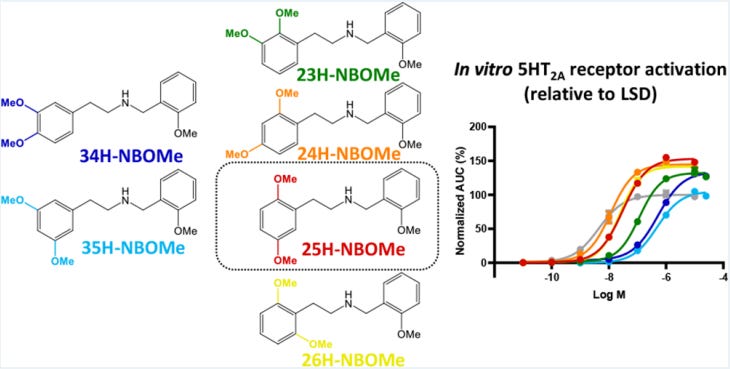
Much like LSD, NBOMe’s have an extremely strong binding affinity for the 5-HT2A serotonin receptors. Activating these receptors is what allows drugs like LSD, psilocybin, DMT, mescaline, and others to produce the psychedelic experience.
When used at the right dose, the effects of NBOMe drugs closely mimic those of LSD — which is why they’re often sold under the name LSD without anybody actually noticing the difference.
On paper, they’re nearly the perfect substitute. They’re potent enough for a dose to fit on blotter paper (few other psychedelics are strong enough to do this), they’re very cheap to synthesize, and they bypass the complex and restrictive chemistry required to produce real LSD.
NBOMe’s saw a particular surge in popularity during the 2010s as new psychoactive substances began proliferating online and in nightlife scenes. These new, “stronger acid” tabs flooded the market around the same time other designer drug markets started to boom (synthetic cannabinoids, benzodiazepines, opioids, and cathinones all saw rapid growth around this time).
Like most shortcuts, the advantages NBOMe’s offered were simply too good to be true.
To understand why these drugs are so damn dangerous, despite targeting the same receptors as LSD, we have to look at exactly how each of these drugs binds to the receptors.
Same Receptor, Very Different Rules
At first glance, NBOMe’s and LSD do the same thing — they bind and activate the 5-HT2A and 5-HT2C receptors. DMT, mescaline, psilocybin, most 2C-X drugs, DOX drugs, and various other groups all target these same receptors, too.
The problem herein lies in the way NBOMes interact with that receptor.
Think of LSD like a key that fits perfectly into a lock. It binds tightly to the 5-HT2A receptor and turns up the volume — not all the way, but enough to feel the effects. Pharmacologists call this partial agonism.
NBOMEs work differently. They’re full agonists. They act more like a battering ram than a key. Instead of gently activating the receptor and settling in, NBOMEs slam into it and push it to the maximum level, over and over again, until the system starts to break.
That extra force doesn’t just amplify visuals or intensity. It spills outward — beyond perception and into the body itself.
The brain isn’t the only place with serotonin receptors. Blood vessels, the heart, kidneys, and peripheral nerves are loaded with them, too. When NBOMEs drive those receptors at full throttle, the effects spill out of the mind and into the body — leading to all sorts of downstream side effects ranging from tachycardia (96%), hypertension (62%), aggression (48%), seizures (37%), and hyperthermia (27%).
NBOMEs strongly constrict blood vessels throughout the body. In emergency rooms, users often arrive with ice-cold hands and feet, blue or pale skin, crushing headaches, and dangerously elevated blood pressure.
NBOMe’s also stimulate the release of thromboxane A2 (TXA2), which, in combination with its vasoconstrictive effects, can further increase the risk of a stroke or heart attack.
Even non-lethal doses of NBOMe can leave lasting side effects. NBOMe’s have been known to cause ventricular fibrillation, psychosis, renal failure, rhabdomyolysis, and vascular disease — sometimes with as little as one dose.
The Point of No Return
NBOMe overdoses are rarely intentional — they mainly arise from impatience.
These drugs are potent, but also notoriously slow to kick in. After an hour or so without any effects, many people assume the “LSD” they bought online was bunk, so they take another dose.
Eventually, the effects of both doses kick in. And they’re STRONG. Overwhelming visuals and sensory distortion start to send the user into overdrive. First, it feels a lot like acid. Then, without much warning, the tone shifts.
Crippling confusion. Agitation. A racing heart. Uncontrollable anxiety. And then collapse.
NBOMe toxicity tends to arrive suddenly and with little warning once it begins.
Because the margin between a “normal” dose and a toxic one is so thin, it’s almost always that second dose — which was taken out of impatience and ignorance that what they had could be anything other than acid — that abruptly pushes the body past its limit.
Once a toxic dose of NBOMe is ingested, there’s no good antidote to remove it. Hospital care involves managing symptoms, preventing blood clots, and boosting detox and elimination pathways until the body can clear the drug on its own. This usually takes around 8 hours, but it can be longer depending on the individual NBOMe (there are several different types) and how much was used.
NBOMEs Feel “Sharp” Instead of Insightful
Despite the risk, some people really do take NBOMe’s on purpose. Some prefer the effects; others take it because LSD itself isn’t available in their area… or is too expensive.
Regardless, not all NBOMe trips are a death sentence. In fact, according to drug-checking services and harm-reduction groups, a large share of users who take counterfeit LSD don’t even know they were given something else. The effects can feel close enough, especially at lower doses, and most trips don’t raise any red flags for danger.
That ambiguity is part of the problem.
I reached out to a few people to ask whether they noticed any subtle differences between NBOMEs and LSD (I’ve never taken any NBOMEs myself, and don’t plan to).
The people I spoke with all described essentially the same thing.
Their NBOMe trips were visually intense but emotionally and spiritually hollow. Bright colors. Distorted faces. Fractals and razor-sharp geometric lines — but without the introspection, empathy, or grounding quality people tend to associate with LSD.
The experience felt forced and thin. “Sharp” was a descriptive word that came up more than once.
How to Avoid NBOMe Exposure
The first step is to recognize that NBOMe’s exist. I think many of the worst outcomes could have been avoided entirely if people didn’t put so much blind trust that the acid they bought online couldn’t possibly be something else.
1. Always Test Your Acid
Acid has no color, no scent, and no taste. It’s impossible to know for sure that what you’re looking at is actually LSD without testing it first.
Luckily, testing at home is very easy, and test kits are cheap to buy online.
First, pick up a kit like this online. Anything that contains the Erlich reagent will do the trick (a kit that includes both the Erlich and Hofmann is even better).
To test a sample, cut a tiny corner of your tab, place it on a ceramic surface (like a plate or mug), and drop one drop of the Erlich reagent (or a scoop of the newer solid reagents). If also using a Hofmann reagent, run both tests separately.
Wait about 30 seconds and assess the color change.
With Erlich, you’re looking for a purple color. A purple reaction means the tab contains indole compounds — a category that includes LSD and closely related lysergamides, as well as DMT. This test won’t tell you exactly which lysergamide you have (AL-LAD, LSZ, ALD-52, ETH-LAD, etc.), but that distinction isn’t the concern here. These compounds share a similar safety profile and produce nearly identical effects.
What matters is when the reagent doesn’t turn purple.
If you get no reaction or a yellow/brown color, you’re most likely dealing with NBOMEs. If the reagent turns orange or light brown, you may have a compound from the DOX family — which can also be dangerous, though generally not as risky as NBOMEs.
The Hofmann reagent is an extra step many people like to use for confirmation, helping differentiate individual lysergamides as well as certain forms of DMT, psilocybin, or LSA. With Hofmann, genuine LSD typically produces a blue reaction.
Testing won’t tell you everything — but it tells you the one thing that matters most — whether the tab you’re holding is actually acid, or something else entirely.
2. “If It’s Bitter, It’s a Spitter”
This little rule of thumb is a useful last-chance warning — but it’s no replacement for actually testing your tabs.
LSD has no taste. If you put the tab in your mouth and discover a bitter or metallic sensation (or any other flavor for that matter), it’s most certainly not acid. NBOMEs have a distinct bitter/metallic taste that often lingers on the tongue or causes a slight numbing sensation.
If you put the tab in your mouth and start to taste bitterness — spit it out.
3. Never Re-Dose
It’s never wise to double down on a drug just because it doesn’t work as quickly as you expect. That’s true for acid — and it’s especially true for substances active at microgram levels.
Alexander Shulgin understood this better than almost anyone.
Over the course of his career, Shulgin designed, synthesized, and documented more than 200 psychoactive compounds — many of which had never existed before. When he believed a new molecule might have psychoactive potential, he didn’t jump straight to a “full dose.” Instead, he used a method called bioassaying.
He would begin with very small amounts — sometimes so small they were expected to do nothing at all. If no effects appeared, he would wait. The next day, he would increase the dose slightly. Then wait again. And again. This process often took several weeks before a compound showed any activity — and sometimes it never did.
But the bottom line here is that he never took two doses on the same day.
That rule wasn’t superstition. It was an acknowledgment that when dealing with unfamiliar chemistry, delayed onset, or extreme potency, stacking doses is the best way to lose control of the experiment.
Shulgin’s patience is one of the reasons he survived decades of self-experimentation with novel substances. He didn’t assume “nothing happening” meant “nothing there.” He knew that doubling down could lead to disaster if the drug had a delayed onset of effects… just like NBOMe’s.
NBOMe Chemistry
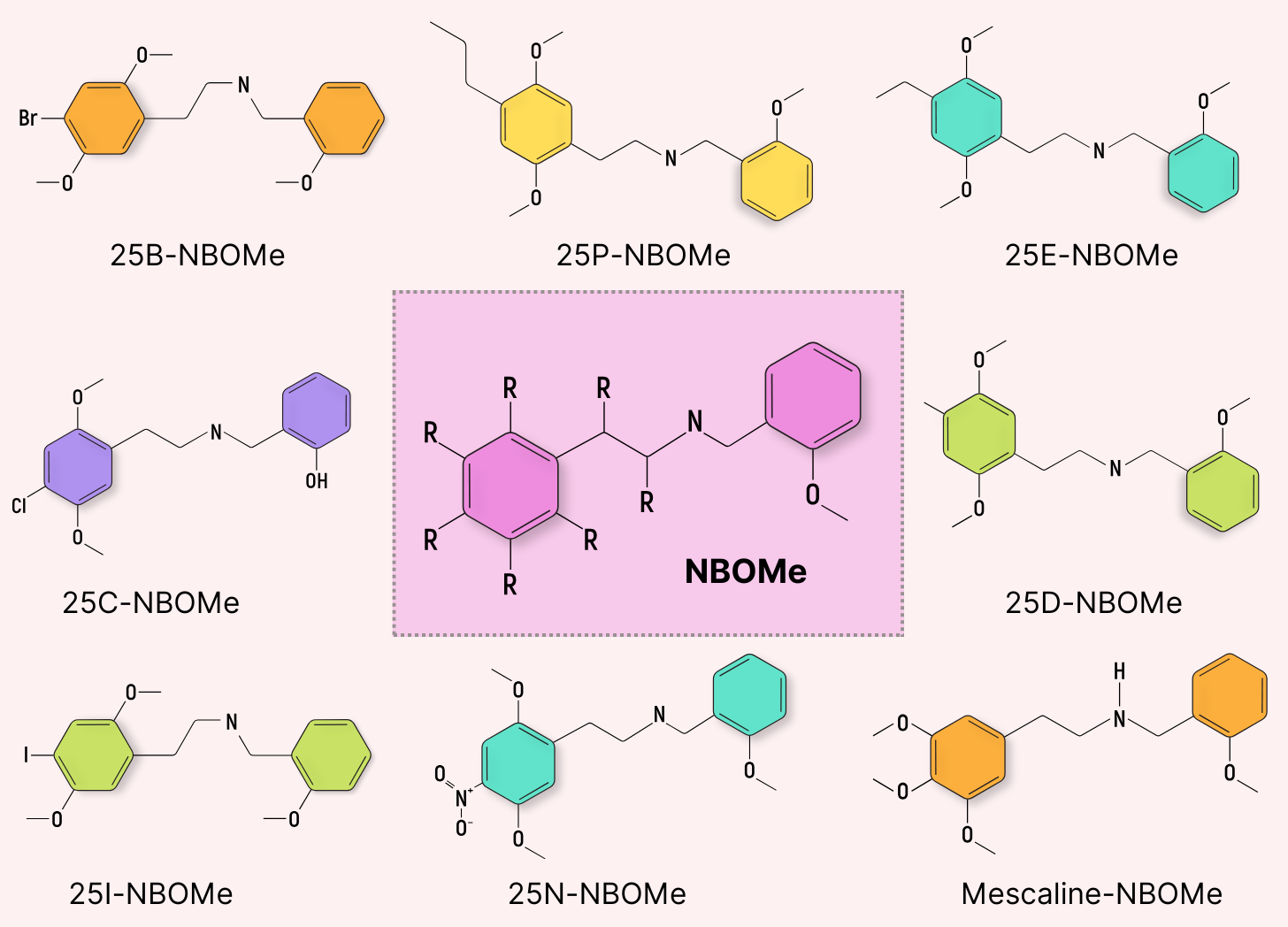
NBOMes are N-benzyl–substituted phenethylamines — most of them derived from the 2C-X family. The added N-benzyl group dramatically increases potency and changes how the drug binds to serotonin receptors.
There are many different types of NBOMe substances, and many more potential combinations that haven’t been invented yet.
Here are the most common:
25I-NBOMe — this is by far the most notorious and widely implicated in fatalities.
25C-NBOMe — Slightly less potent than 25I, but still extremely dangerous.
25B-NBOMe — Very similar risk profile; less common but still documented in overdoses.
Other, less common NBOMe variants include:
25D-NBOMe
25E-NBOMe
25H-NBOMe
25N-NBOMe
The Takeaway
NBOMEs aren’t “stronger acid.” And they aren’t dangerous just because people use them irresponsibly.
They’re dangerous because of what they are.
A full-force serotonergic drug with no safety buffer, sold under false pretenses, with unpredictable and often systemic effects on the body and mind.
There is no insight here worth the risk. No lesson that can’t be learned elsewhere with safer, more tried and tested substances.
This was a really great and readable guide. Always thought they were a drug to avoid at all costs - doubling down on that now .