

Can Psychedelics Break the Consumption Cycle?
Consumer culture doesn’t just shape what we buy — it shapes what we want. Here’s why that’s harder to escape than you think.


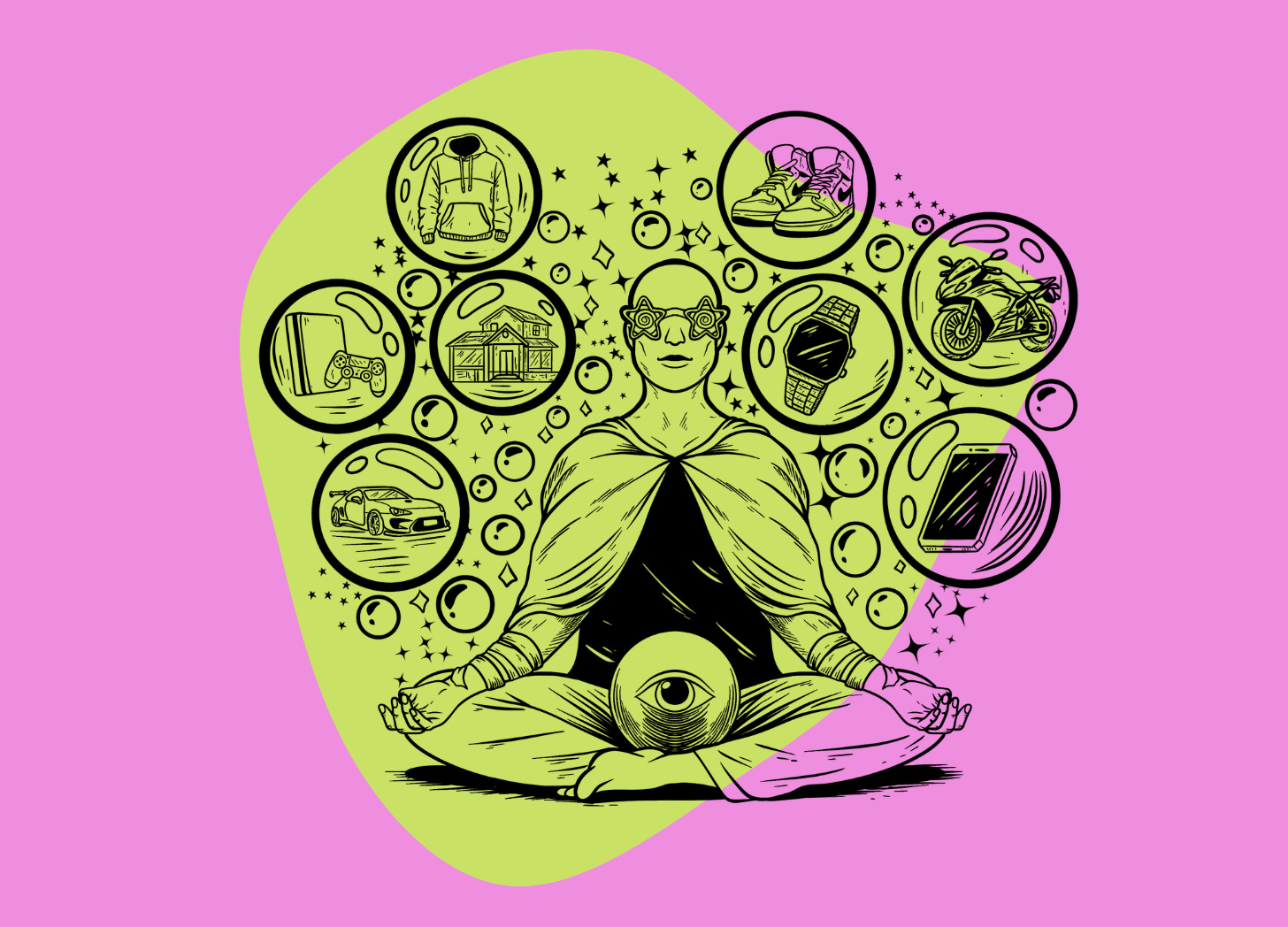
Our culture is obsessed with buying. We replace perfectly functional devices every 2–3 years, even though modern smartphones are engineered to last far longer.
We buy based on trends and unconscious signalling rather than actual functional need.
The result of our pathological consumerism is now visible from space — vast mountains of fast-fashion, discarded electronics, and plastic packaging are piling up faster than they can decompose.
The Federal Reserve’s national accounts data show personal consumption expenditures consistently make up roughly 65–70% of US GDP. The economy literally depends on people continuously purchasing goods and services year after year.
Not occasionally. Not when necessary. Continuously. We cannot stop.
On a more personal level, buying something new is exciting.
It comes with a promise of a new identity, something different we can try on to see who we might become. We feel refreshed and upgraded, as though we’ve moved forward in some important way.
While the lift is real, it’s also short-lived. What felt exciting and meaningful quickly becomes normal and routine until it’s no longer enough to satisfy us. Psychologists call this the hedonic treadmill (more on this in a second).
The same loop appears online. Doomscrolling is simply a faster, more compressed version of the hedonic treadmill — a rapid cycle of novelty, brief stimulation, and immediate fading. We constantly chase that next small hit of dopamine, which disappears almost instantly, and the scroll continues.
With this pattern, satisfaction will always remain just out of reach.
Some fascinating research suggests that psychedelics — widely recognized as being “pattern interuptors” — may offer us an escape route. Not from consuming itself, but from the psychological conditions that keep us trapped in it.
The Hedonic Treadmill
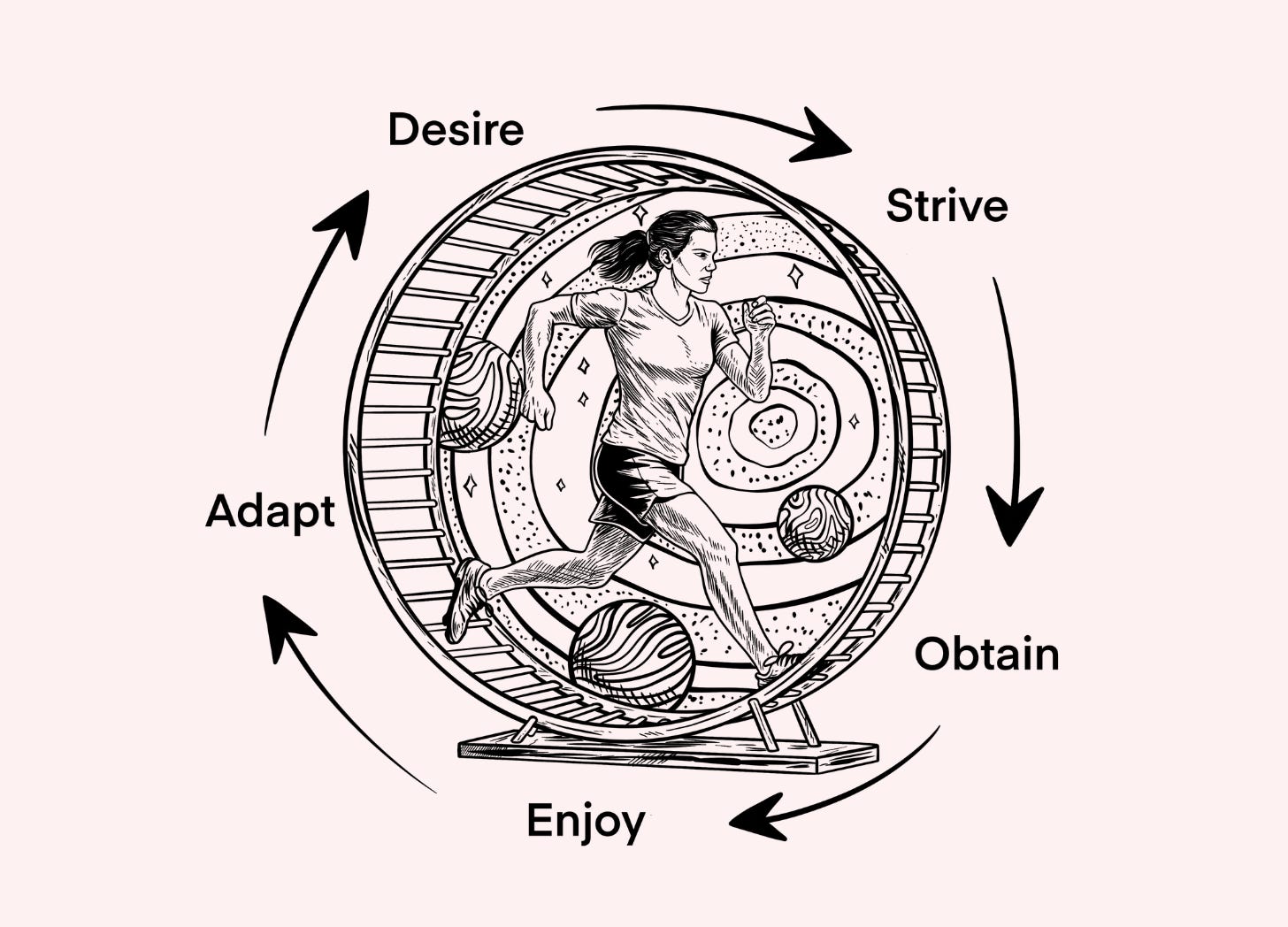
The hedonic treadmill, as described by Canadian psychologist Philip Brickman and American psychologist Donald Campbell back in 1971, is a cycle of endless wanting.
It goes as follows:
We strive for a change (a purchase, upgrade, or improvement) and feel a rise in excitement.
We obtain it and enjoy a temporary boost in happiness.
We adapt, and the happiness normalizes. Our expectations reset, and satisfaction fades.
We desire the next improvement, and the cycle starts all over again.
The core idea here is that humans have a “set point” for happiness. When something pushes us outside this baseline, we gradually adjust until it feels normal again.
This works both ways — when something makes us sad, we learn to rationalize or soften it. When something makes us happy, we normalize it, and the feeling fades.
Because of this, satisfaction never lasts long — but the desire for improvement does.
The treadmill continues to perpetuity — not because we’re weak or irrational, but because the loop is so automatic. We don’t consciously decide to want the next thing — we simply find ourselves wanting it.
This is why willpower and rational argument usually fail as solutions to the reflexive overconsumption problem. You can’t think your way off a treadmill you don’t realize you’re on.
This is where psychedelics become interesting.
Psychedelic experiences appear to interrupt these automatic patterns at the subconscious level. They don’t directly suppress desire — they loosen the scaffolding that keeps the hedonic loop running in the first place.
When that grip starts to loosen, the treadmill has nothing left to run on.
How Psychedelics Loosen the Psychology of Consumption
If consumerism rides on the psychology of endless wanting, the real question is “what happens if we can change the structure of wanting itself?”
Psychedelic experiences may offer us a path toward that change.
Here’s what the research says so far…
1. Psychedelics Deepen Our Connection to Nature
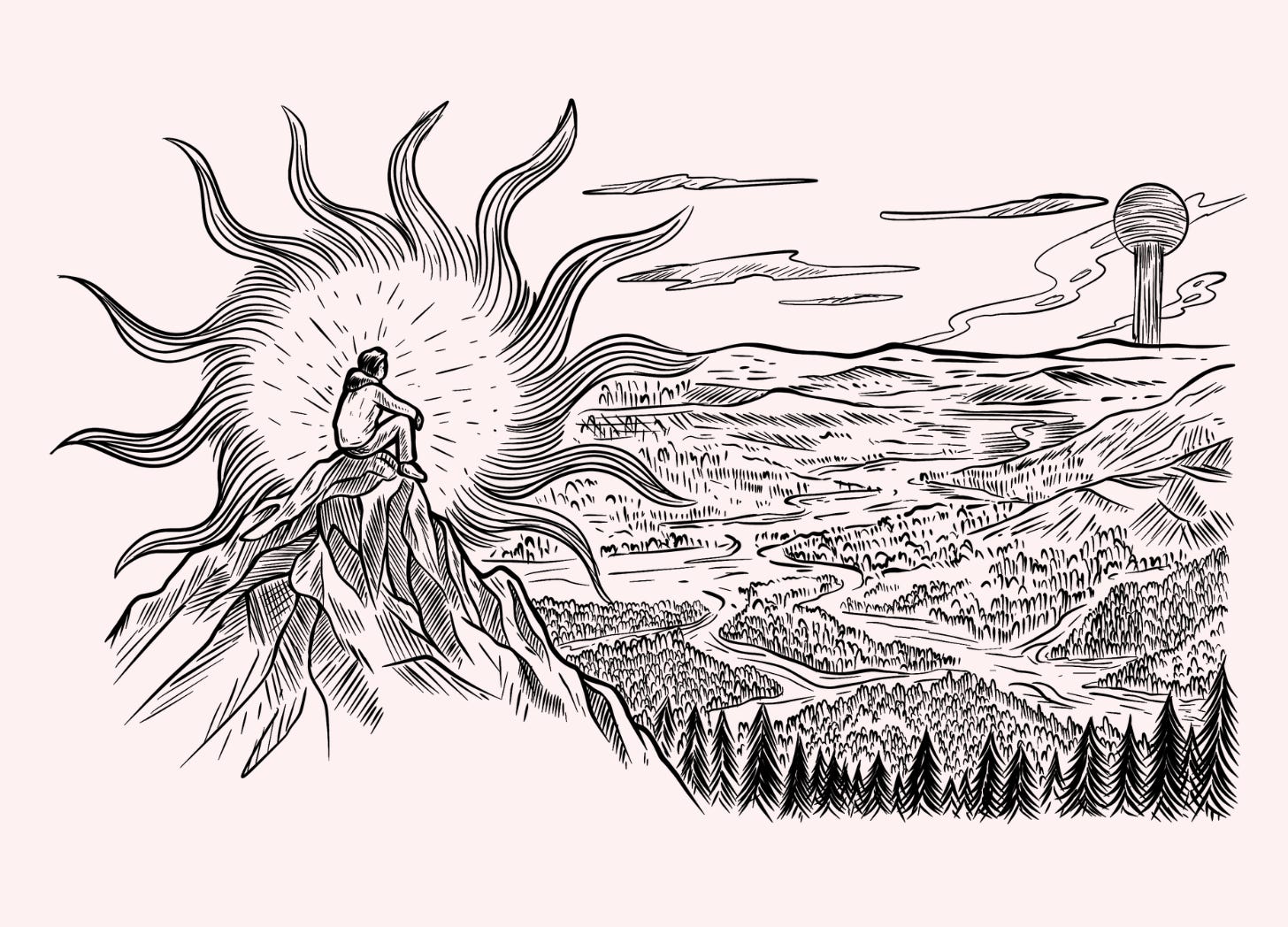
The further away we get from nature, the more we buy.
One study found that psychedelic experiences reliably increase a person’s sense of connection to nature — often lasting months to a year or more.
Why does this matter?
It matters because evidence suggests higher materialistic values (I’m talking about the consumer-value kind, not the metaphysical worldview) reliably predict lower ecological concern and a weaker connection to nature, while stronger nature-relatedness predicts reduced materialism and greater well-being.
Essentially, people who feel embedded in the living world tend to value care, sufficiency, and experience over accumulation and status-signaling.
A set of experiments from 2020 found that simply viewing natural environments — forests, trees, or mountains — reduced how much importance participants placed on wealth, status, and image compared to viewing urban settings.
Put more simply: when the world feels more alive, interconnected, and sacred — we feel less compelled to extract status and identity from it.
2. Psychedelics Shift What We Find Meaningful
The more we identify with our image, the more we buy.
Psychedelics don’t just create unusual experiences — they reorganize how a person interprets reality. That can leave a lasting impact on how we decide what’s truly important to us — and what’s just noise.
Both psychedelic or other spiritual revelations can produce what’s sometimes called ‘ontological shock‘ — a sudden and disorienting shift in worldview where previously unquestioned assumptions stop feeling self-evident. It brings a feeling that everything you’ve taken for granted and based your life around may be incomplete or false.
This experience can be destabilizing at first… but it can also fundamentally reshape our motivations. This includes our attitudes toward consumption.
Part of this shift comes from psychedelics’ ability to induce direct experience — the kind of understanding we can only get firsthand.
This kind of knowledge cannot be transmitted by hearing it from others, reading about it, or watching someone describe it. These include moments of shock and awe, overwhelming beauty, and deep meaning.
These moments feel intrinsically fulfilling. They make symbolic substitutes like status objects, superficial upgrades, and lifestyle signaling feel empty by comparison.
Another common feature is a heightened sense of impermanence — the realization that we’re all going to die, and we can’t bring our wealth or status with us when we go.
When time feels finite and tangible rather than abstract and distant, the logic of endless accumulation starts to feel meaningless.
“What’s the point of constantly performing and accumulating objects and paper wealth if the experience of living itself is the thing that actually matters?”
Realizations like this shift our priorities from optimizing one’s outward image to simply using the limited time one has well.
This shift is fairly abstract, but there are some interesting studies that support it:
A) Reality & Meaning
A large prospective study found psychedelic experiences were associated with sustained shifts away from strictly materialist worldviews toward greater openness and interconnectedness.
The idea here is that when people stop seeing reality as just “stuff and success,” they may begin finding meaning in experience itself rather than in achievements or possessions.
B) Reduced Authoritarian Attitudes
In another study, researchers observed a measurable decrease in rigid, hierarchical thinking following psilocybin treatment. This was interpreted as a loosening of status- and dominance-oriented value systems.
When people feel less driven to place themselves above or below others, the need to signal success through what they own becomes less… compelling.
This matters because consumer culture depends heavily on sorting people into perceived levels of worth (hierarchy), evaluating ourselves relative to others (status comparison), and turning possessions into a language for communicating who we are (identity signalling).
This essay from the Onward Podcast Substack made the observation that people who have undergone a shift in consciousness often step back from participating in performative social systems (like social media, mimetic buying, and other social comparison rituals).
The argument isn’t that the exodus is fuelled by rebellion, but because the motivations that once sustained participation (comparison, status seeking, and social validation) lose their grip after someone realizes a more intrinsic source of fulfillment.

3. Psychedelics Foster Deeper Connection With Others
Feeling connected to others reduces our need to signal through buying.
Consumer psychology research shows a significant portion of the buying cycle (or should I say trap?) is driven by social belonging. We don’t just purchase things for their function — we buy them to align with others and avoid social exclusion.
People will often strain their finances — even taking on debt — for a new car, new phone, or new wardrobe so they can be perceived as successful. It isn’t about transportation or clothing alone — reliable used options exist for far less. It’s not about the function an item gives us either — it’s about what they signal about us that matters.
Psychedelics may help soften some of this socially driven buying pressure.
In a 2018 Johns Hopkins study, participants who underwent a psilocybin session reported lasting increases in prosocial attitudes and feelings of interpersonal closeness. They felt more connected to the people around them.
Other research has similarly linked psychedelic experiences to heightened empathy and social connectedness. Participants often describe feeling less judged by others — and less preoccupied with judging themselves.
A 2022 review on “psychedelic sociality” found these substances don’t just create positive feelings — they appear to reduce social threat processing while increasing affiliative signals like empathy and trust.
In other words, the brain shifts from guarding social position to participating in social connection. That’s a huge difference.
The basic idea here is simple: if others feel like they’re our competitors, we signal — and buying becomes a big part of that process.
If others feel like our allies, we relax. We don’t feel as much pressure to buy things to prove our worth. Status objects become less necessary.
Step Off the Treadmill
Psychedelics are excellent pattern interruptors — research has repeatedly shown that psychedelic experiences can break the cycles involved in depression, addiction, and PTSD. The research we’ve explored here suggests they may interrupt the patterns of consumption and wanting, too.
But the real revelation isn’t that we all need to go out and drop acid — it’s that we should question the nature of our wanting itself.
Most of what drives us to consume isn’t genuine need, it’s psychological conditioning — ego maintenance, social threat, disconnection, a hunger for meaning we haven’t found elsewhere.
Our obsession with buying is just a symptom.
I think the more useful takeaway from all this is to simply pay attention to the pull of desire. To question yourself next time you reach for your credit card:
“Why do I actually want this?”
“Is this meeting a real need, or managing an image?
Is it adding something to my life, or filling a gap I haven’t looked at directly?”
You don’t need a psychedelic experience to step off the treadmill, but you do need to notice you’re on one.
As Bob Dylan so wisely wrote and sung: "advertising all is phony". Of course in our consumer culture and thanks to clever advertising, in order to connect with nature properly we need the latest gear and gadgets: tech clothing, tents, sleeping bags, packs, skis, climbing gear, hiking boots ad infinitum. And this represents a fraction of overall conspicuous consumption. Yikes!